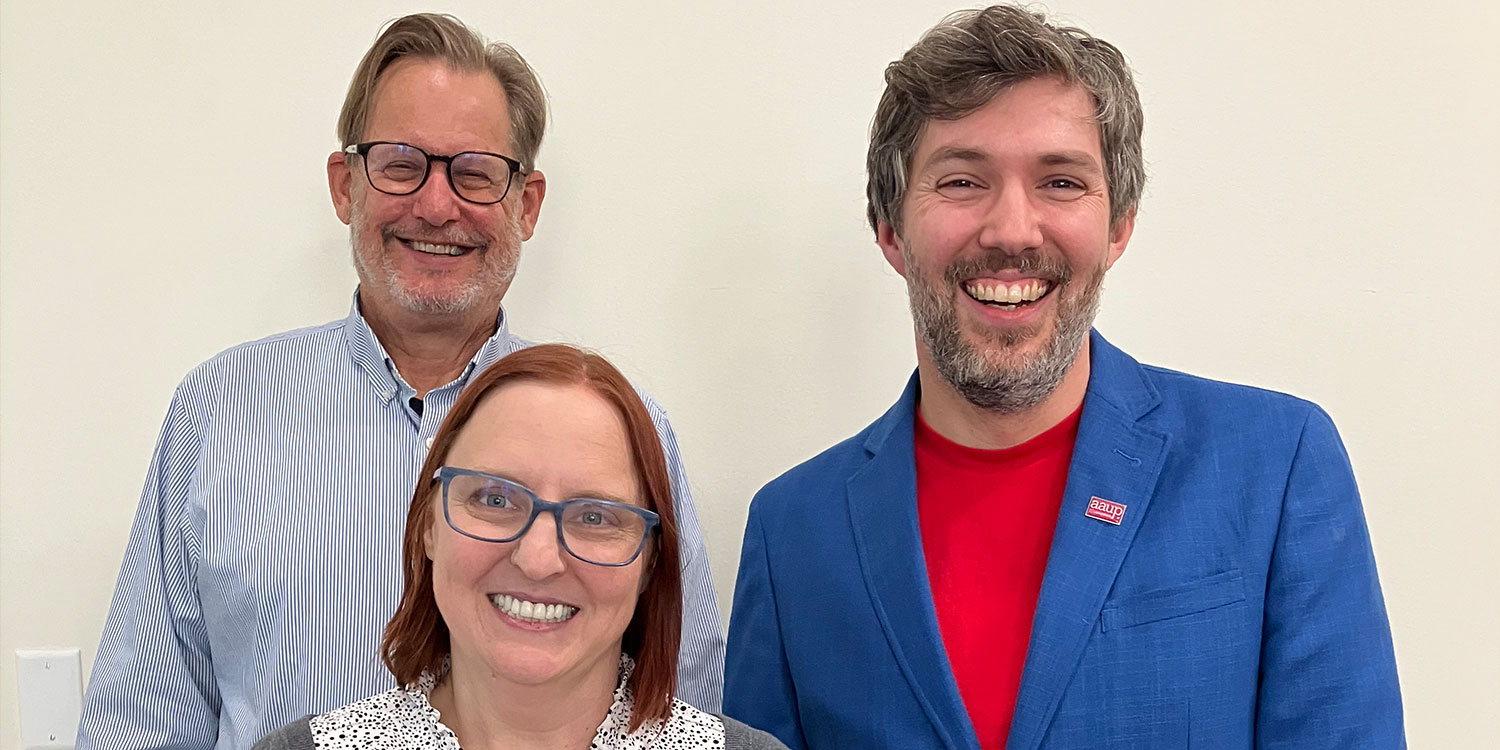
On October 2, a small group of faculty members, students, and staff gatheredin the Convergent Media Center for a conversation about academic freedom.Dr. Liam O’Loughlin, chapter president of the American Association of University Professors (AAUP),createdthe eventtoprocessnational issues facing educators today.
The AAUP wasestablishedin 1915to examineand investigateissues of academic freedom. Their first list of charter members included 900 professors from 61 institutions, including 20 professors fromThe OhioStateUniversity and 12 from the University of Cincinnati.Today, theyrepresent45,000 membersand 2,000 institutions.
The association created the“Declaration of Principles on Academic Freedom and Academic Tenure”to elucidate their position: “Once appointed, the scholar has professional functions to perform in which the appointing authorities have neither competency nor moral right to intervene. The responsibility of the university teacher is primarily to the public itself, and to the judgment of his own profession."
The early AAUP believedthat professors should havefreedom of inquiry and research,freedom to teach in the way they see fit, and freedom of expression and action even outside of the university environment.
“In the early 20th century, academic freedom is deeply tied to professors figuring themselves out as a profession,” O’Loughlin said.
For the next 100 years, they worked tobring fairness and self-governance tovarious aspects of academic life, including women's representationin university positions, faculty salaries, and professional ethics. Albert Einstein was a member, as was Franklin Delano Roosevelt.
Today, atsomeuniversities, the AAUP acts as a labor union, but at 热博体育,itoperatesas a faculty advocacy organization.
O’Loughlin hasbeen president of 热博体育’s AAUP chapter since 2024.
“It’san important role for me because I canbean active voice inadvocating forfaculty on campus,” O’Loughlin said.“AAUP is also active on state and national levels, advocating for improvements to faculty working conditions and protecting our rights. My role as chapter president allows me to connect 热博体育 to the wider context of higher education workers.”
For this event, O’Loughlin partnered with Dr. Andy Carlson, history professor, and Dr. Elizabeth Klainot-Hess, assistant professor of sociology and criminology.
“We were inspiredto organize this event because of the increasingly hostile environment for teaching,especially onrace, gender, and sexuality, both at the state and national levels,” O’Loughlin said.“I wanted a more textured sense of the conversation, one that connects academic freedom to real working conditions.”
“I was inspired to plan and participate in this event because academic freedom is important to me,” Klainot-Hess said. “I believe it is important for people to have knowledge of this topic and have the opportunity to discuss it.”
Carlson began the conversation by offering a chronology of the AAUP’s efforts, noting their evolution over time.
“Academic freedom,” Carlson said, “is a living project.”
Carlson emphasized the association’s tenet that schools, universities, and faculty are “a public good” that needs to be sheltered from censorship.This protection would allow academicinstitutions “to promote inquiry and advance the sum of human knowledge,” in service to the national community.
“Academic freedom to pursue knowledgeisinstitutionallyand politically fragile,” Carlson said. “Students, other faculty members, administrators, board members, and the larger society can withdraw their support for free inquiry.”
Klainot-Hess, assistant professor of Sociology & Criminology, shifted the conversation to present-day events,discussing the challenges faced by contingent andadjunct faculty, who lack the benefits and protection of tenure.
She explained thatcontingent faculty can be fired forwhat they say, what they teach, the content of their assignments and readings, their social media posts, and even activities outside the classroom. When surveyed,manyreport havingself-censored due to a desire to sound neutral.
Non-tenuredadjuncts and lecturerscurrentlycomprise75% of allfaculty.They are hired on short-term contractswith no expectation of permanence, make low wages, and usuallyare not eligible for benefits.
According to Klainot-Hess’s presentation,unprotected faculty across the country have been fired for a widerange of actions, includingcriticizing the college’s COVID-19 response, assigning students to investigate local industrial pollution,and speaking out about dumbing down the curriculum.
The conversation concluded witha shortQ&Aand discussion period.Attendees talked about the status of the AAUP’s recent lawsuitsandcurrent strategies.They considered how to restore the sense that professors arestewards of knowledge in service of the public good.They put hope in the shifting tides of the future.
“A concrete goal of the event was to better inform the audience, and to reinforce our campus's commitment to academic freedom,” O’Loughlin said. “I hope the event demystified some things and opened up better, more informed questions.”